Onion snail
- Algae grazing
- High
- Breeding speed
- Not applicable
- Population growth
- Low
- Adult size
- Varies
- Lifespan
- 1–2 years
- Water
- 22–28 °C
Up to about 25 mm shell width in the UK wholesaler’s account; individual sizes differ.
- Eats plants
- No
- With shrimp
- Yes
What is an onion snail?
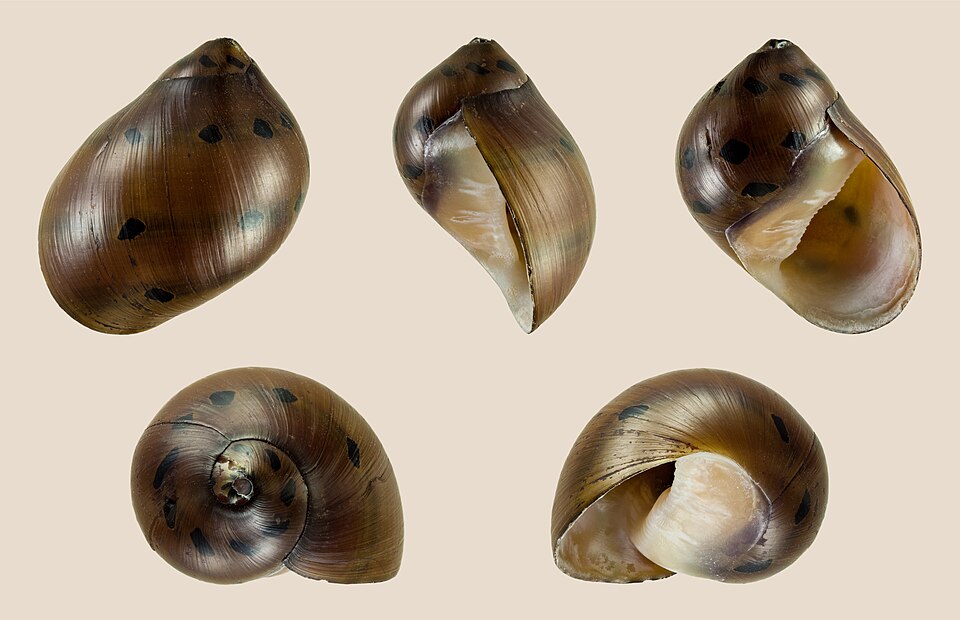
This guide covers the red onion or orange-track nerite sold as Vittina semiconica, formerly Neritina semiconica. It belongs within the broader nerite group, not a separate colour form of every zebra nerite. Dots and broken track-like markings vary; pattern alone does not resolve identification. The photograph shows a documented shell specimen in several views, not a living shop animal.
Scientific scope: Vittina semiconica
Quick stats
Water
- Water temperature
- 22–28 °C
- pH
- 7.2–8.2 pH
Tank mates
- With shrimp
- Yes Peaceful shrimp with compatible mineral and temperature needs.
- With fish
- Caution
- With other snails
- Caution
Home
- Starting tank
- 45 litres Starting suggestion for one in a mature tank with plentiful algae and biofilm; extra grazers need more food and space.
- Secure lid
- Yes
Habits
- Lifespan
- 1–2 years
- Active time
- Night
How big do they get?
The UK wholesaler gives about 25 mm shell diameter. This is width, not height. An orange or spotted shell alone is not a reliable species test; ask for the scientific name.
- Adult shell size
- Varies Up to about 25 mm shell width in the UK wholesaler’s account; individual sizes differ. Fact source
Sources and scope
J&K Aquatics, UK wholesaler, red onion snail sold as Vittina semiconica: size, lifespan and water guidance.
Checked 2026-11-02
How long do they live?
The supplier estimates 1–2 years. Some care accounts report longer lives, so use this conservatively; the age of a purchased adult is often unknown.
- Lifespan
- 1–2 years Conservative supplier estimate; longer lives are reported elsewhere, with age at purchase usually unknown. Fact source
Sources and scope
J&K Aquatics, UK wholesaler, red onion snail sold as Vittina semiconica: size, lifespan and water guidance. Longer estimates: https://my-fish.org/my-fishothek/vittina-semiconica-ornament-rennschnecke/ .
Checked 2026-11-02
What do they eat?
Give access to established algae and biofilm on stones, wood and glass. Prepared foods may be refused, so a spotless new aquarium can leave this grazer hungry.
- Diet type
- Herbivore Algae and biofilm specialist; prepared food may be refused. Fact source
Sources and scope
Aquarium Dietzenbach, Vittina semiconica husbandry: mature grazing surfaces, 45-litre starting tank and compatibility.
Checked 2026-11-02
Do they eat plants?
Healthy plants are normally left intact while surface growth is grazed. This is a useful distinction from the plant-eating great pond snail, which you can compare in the Index.
- Plant eating
- No Healthy plants normally left intact. Fact source
Sources and scope
Frank Schäfer, Aquarium Glaser (12 January 2024), directly imported Vittina turrita and V. semiconica; shell patterns, separate sexes and saline larval development.
Checked 2026-11-02
Do they eat algae or clean the tank?
A strong grazer of soft surface algae and biofilm. It will not reliably clear every algae type; keep enough edible growth available.
- Algae role
- High Surface grazing is central to feeding; not every algae type is eaten. Fact source
Sources and scope
Aquarium Dietzenbach, Vittina semiconica husbandry: mature grazing surfaces, 45-litre starting tank and compatibility.
Checked 2026-11-02
What eats them?
Exclude puffers, snail-eating loaches, assassins and predatory crustaceans. Peaceful appearance or a larger shell does not make those pairings safe.
- Predators
- Puffers, snail-eating loaches, assassin snails and predatory crustaceans. Crustaceans: Aquarium Dietzenbach compatibility guidance. Fact source
Sources and scope
J&K Aquatics, UK wholesaler, red onion snail sold as Vittina semiconica: size, lifespan and water guidance. Crustaceans: Aquarium Dietzenbach.
Checked 2026-11-02
Are they safe with shrimp, fish and other snails?
Peaceful shrimp can work when water needs overlap. Avoid predators and too many competing grazers. Use the nerite variation link for the broader group guide; this page covers the onion type.
- With shrimp
- Yes Peaceful shrimp with compatible mineral and temperature needs. Fact source
- With fish
- Caution Non-predatory fish only. Fact source
- With other snails
- Caution Peaceful snails only; exclude assassins and avoid grazing competition. Fact source
Sources and scope
Aquarium Dietzenbach, Vittina semiconica husbandry: mature grazing surfaces, 45-litre starting tank and compatibility.
Checked 2026-11-02
How many per tank?
Use 45 litres for one as the more spacious supplier starting point, with abundant grazing. J&K lists 20 litres; food availability and companions decide suitability, not volume alone.
- Starting tank volume with conditions
- 45 litres Starting suggestion for one in a mature tank with plentiful algae and biofilm; extra grazers need more food and space. Fact source
Sources and scope
Aquarium Dietzenbach, Vittina semiconica husbandry: mature grazing surfaces, 45-litre starting tank and compatibility. Alternative 20-litre minimum: J&K Aquatics.
Checked 2026-11-02
Do they need a heater, or can they live in cold water?
Use 22–28°C following the UK supplier. A heater is needed where room conditions cannot maintain a stable suitable temperature.
- Recommended water temperature
- 22–28 °C Fact source
Sources and scope
J&K Aquatics, UK wholesaler, red onion snail sold as Vittina semiconica: size, lifespan and water guidance.
Checked 2026-11-02
What water do they need?
The UK guidance gives pH 7.2–8.2 and GH 10–25°dGH. Check compatibility before adjusting minerals; this is general hardness, not KH.
- pH
- 7.2–8.2 pH Fact source
- Hardness guidance with units
- GH 10–25°dGH in the UK wholesaler’s guidance; stable mineral-rich water. Fact source
Sources and scope
J&K Aquatics, UK wholesaler, red onion snail sold as Vittina semiconica: size, lifespan and water guidance.
Checked 2026-11-02
How do they breed, and how fast?
There are separate males and females. They may lay eggs in freshwater, but the larvae need a saline development phase. Adding salt to a community tank is not a breeding method.
- Can reproduce in a freshwater aquarium
- No Egg capsules may be laid; larvae do not complete development in ordinary freshwater. Fact source
- Breeding speed
- Not applicable No normal freshwater recruitment; this does not mean no eggs. Fact source
- Pair needed
- Yes Separate sexes for fertilisation; a pair alone does not make freshwater breeding possible. Fact source
Sources and scope
Frank Schäfer, Aquarium Glaser (12 January 2024), directly imported Vittina turrita and V. semiconica; shell patterns, separate sexes and saline larval development.
Checked 2026-11-02
What do the eggs look like, and how long do they take to hatch?
White, hard capsules attach to décor and other firm surfaces. They are not evidence of an impending freshwater colony. A simple hatching countdown would misrepresent the larval stage.
- Reproduction type
- Egg laying Fact source
- Hatching time
- Not applicable No freshwater baby-snail countdown: a saline larval phase is needed. No validated species-specific incubation schedule is supplied here. Fact source
Sources and scope
Frank Schäfer, Aquarium Glaser (12 January 2024), directly imported Vittina turrita and V. semiconica; shell patterns, separate sexes and saline larval development.
Checked 2026-11-02
Are they good or bad, and how do I get rid of them?
Freshwater population growth is low, though egg capsules may be unwelcome. Consider that before adding one; buying more to remove algae also means more mouths to feed. Never release aquarium snails outdoors.
- Population growth concern
- Low Low population growth in freshwater; visible egg capsules are still possible. Fact source
Sources and scope
Frank Schäfer, Aquarium Glaser (12 January 2024), directly imported Vittina turrita and V. semiconica; shell patterns, separate sexes and saline larval development.
Checked 2026-11-02
Are they nocturnal, and why do they hide?
Often more active after dark, with daytime grazing possible. Check behind décor before assuming it escaped. Regular burrowing has not been established by the reviewed species sources.
- Active time
- Night Often more active after dark; daytime grazing also occurs. Fact source
- Burrows
- Not known The species guide describes hard-surface grazing, but does not establish whether individuals regularly bury themselves. Fact source
Sources and scope
Zoopet, Vittina semiconica aquarium account; mainly nocturnal activity. Substrate scope: Aquarium Dietzenbach, linked in the burrowing fact.
Checked 2026-11-02
Can they survive out of water or climb out?
Use a secure, ventilated lid and close cable gaps. Check the rim when one disappears; these snails can leave the water.
- Secure lid needed
- Yes Cover escape gaps while retaining ventilation. Fact source
Sources and scope
Aquarium Dietzenbach, Vittina semiconica husbandry: mature grazing surfaces, 45-litre starting tank and compatibility.
Checked 2026-11-02
Is it dead, or just not moving?
Rest and hiding can resemble inactivity. Check water and available grazing first; investigate lasting changes without forcing open the operculum.
Sources and scope
Pro Shrimp, keeper guidance: inactivity alone does not establish death.
Checked 2026-11-02
Why is the shell damaged, and do they need calcium?
Suitable mineral content supports shell growth. Review pH, hardness and feeding if erosion appears; avoid sudden mineral additions.
- Calcium required
- Yes Fact source
Sources and scope
Aquarium Dietzenbach, Vittina semiconica husbandry: mature grazing surfaces, 45-litre starting tank and compatibility.
Checked 2026-11-02
About this identification
MolluscaBase via WoRMS, accepted Vittina semiconica; Neritina semiconica is the original combination. Trade names: J&K Aquatics. Pattern and V. turrita distinction: Aquarium Glaser.
Identification reference · checked 2026-11-02
Keep them contained: never release aquarium snails or eggs into the wild.