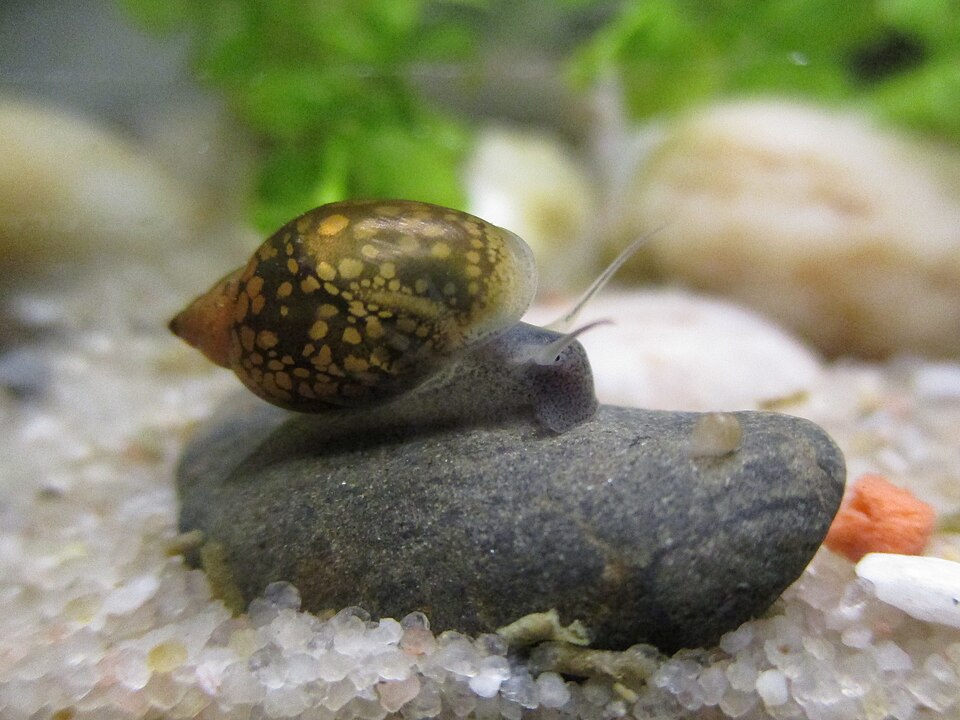
Ramshorn snail
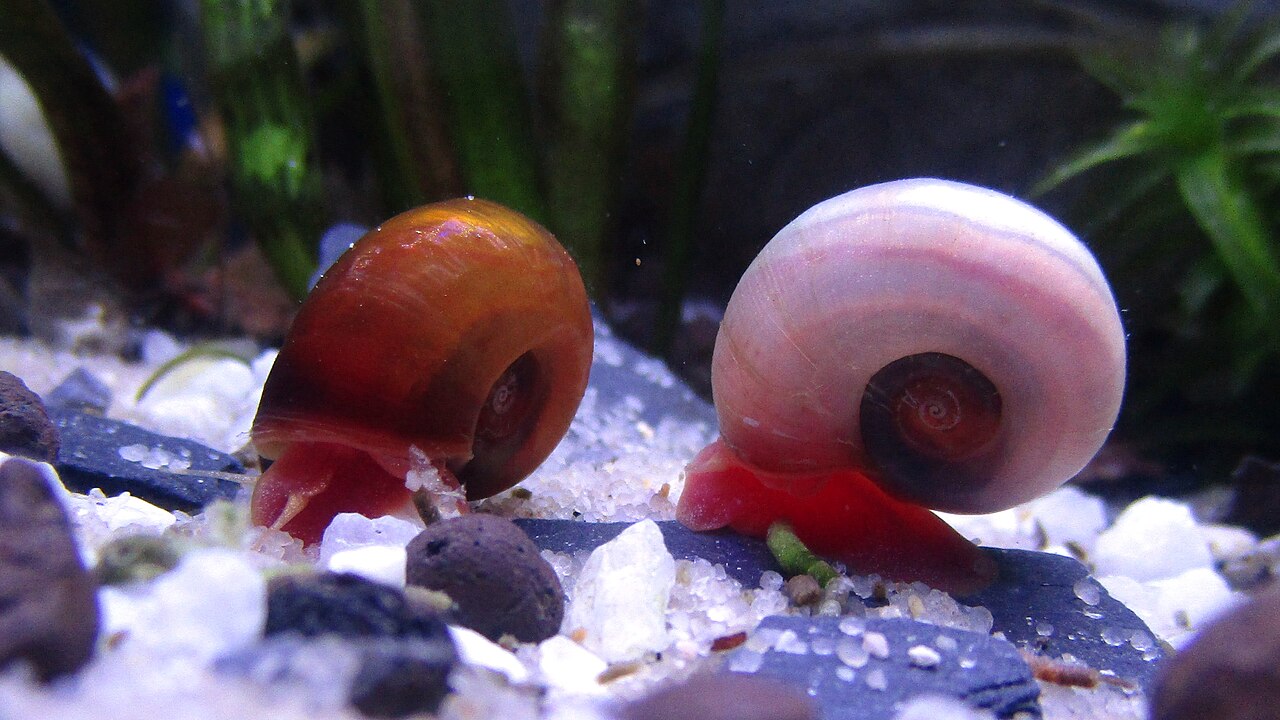
- Algae grazing
- Some
- Breeding speed
- High
- Population growth
- High
- Adult size
- 20–25 mm Shell width
- Lifespan
- 1–3 years
- Water
- 18–25 °C
- Eats plants
- Sometimes
- With shrimp
- Yes
What is a ramshorn snail?
This entry focuses on Planorbella duryi, the small aquarium ramshorn with selectively bred colours. Helisoma duryi is an older name in research. It does not cover every ramshorn: Planorbarius corneus grows larger, and the giant ramshorn Marisa cornuarietis belongs to another family. Colour alone cannot identify a hitchhiker.
Scientific scope: Planorbella duryi
Quick stats
Water
- Water temperature
- 18–25 °C
- pH
- 7–8 pH
Tank mates
- With shrimp
- Yes Peaceful dwarf shrimp with compatible water conditions.
- With fish
- Caution
- With other snails
- Caution
Home
- Starting tank
- 20 litres A small starting group in a mature, filtered tank. Five US gallons rounded up; population growth and fish may require more space.
- Secure lid
- Yes
Habits
- Lifespan
- 1–3 years
- Active time
- Day and night
How big do they get?
Allow for a shell about 20–25 mm across in an adult P. duryi. That combines a roughly 20 mm field report with an aquarium upper estimate near 25 mm. Larger ramshorn namesakes need their own assessment.
- Adult shell size
- 20–25 mm (Shell width) Approximate adult planning size across the round shell: field account about 20 mm; aquarium account up to about 25 mm. Not an exhaustive observed range. Fact source
Sources and scope
US Fish and Wildlife Service (2025 web version), Planorbella duryi assessment; includes Taybi et al. adult shell measurements. Aquarium upper estimate is linked in the size fact.
Checked 2026-11-01
How long do they live?
Usually around one year in the cited keeper experience, with occasional animals reaching two or three. The comparison span includes those longer-lived exceptions.
- Lifespan
- 1–3 years Usually nearer one year; two to three years is exceptional in the cited keeper experience. Fact source
Sources and scope
The Shrimp Farm, aquarium ramshorn care; distinguish Planorbella duryi from larger namesakes.
Checked 2026-11-01
What do they eat?
They scavenge leftovers and graze surface growth. Offer small portions of suitable sinking food when needed, then remove leftovers; deliberately overfeeding creates extra waste and more snails.
- Diet type
- Omnivore Fact source
Sources and scope
Aquatic Arts, red aquarium ramshorns; husbandry and compatible non-predatory companions.
Checked 2026-11-01
Do they eat plants?
Usually they favour decaying material. Very soft plants or insufficient food can change that, so sometimes is more useful than an unconditional plant-safe promise.
- Plant eating
- Sometimes Usually dead material; tender plants or hungry snails can be exceptions. Fact source
Sources and scope
The Shrimp Farm, aquarium ramshorn care; distinguish Planorbella duryi from larger namesakes.
Checked 2026-11-01
Do they eat algae or clean the tank?
They graze some algae on glass, leaves and decorations. Sources disagree about particular tough algae, so do not choose ramshorns as a guaranteed cure for green spot algae.
- Algae role
- Some Some surface grazing; not dependable whole-tank algae control. Fact source
Sources and scope
Aquarium Care Basics, keeper observations of aquarium ramshorns; stock not independently identified. Conflicting claim: The Shrimp Farm ramshorn care, linked in the plant section.
Checked 2026-11-01
What eats them?
Puffers, snail-eating loaches, larger predatory fish and many crabs or crayfish can eat them. Do not add a predator solely for pest control without meeting its own care needs. Keep assassin snails separate: they can prey on these snails.
- Predators
- Puffers, snail-eating loaches, large predatory fish, crabs, crayfish and assassin snails. Fact source
Sources and scope
The Shrimp Farm, aquarium ramshorn care; distinguish Planorbella duryi from larger namesakes. Assassin predation: https://www.aquariumcoop.com/blogs/aquarium/assassin-snail (checked 2026-11-02).
Checked 2026-11-02
Are they safe with shrimp, fish and other snails?
They generally fit peaceful shrimp aquariums. Check the water needs of fish and other snails too. Assassin snails are predators, and young ramshorns are easier prey than adults.
- With shrimp
- Yes Peaceful dwarf shrimp with compatible water conditions. Fact source
- With fish
- Caution Non-aggressive fish only; tiny offspring remain vulnerable. Fact source
- With other snails
- Caution Peaceful species only; assassin snails can eat ramshorns. Fact source
Sources and scope
Aquatic Arts, red aquarium ramshorns; husbandry and compatible non-predatory companions.
Checked 2026-11-01
How many per tank?
For a small starting group, choose 20 litres or more with a mature filter. Count future offspring and other livestock when planning space. A starting tank recommendation is not a permanent population allowance.
- Starting tank volume with conditions
- 20 litres A small starting group in a mature, filtered tank. Five US gallons rounded up; population growth and fish may require more space. Fact source
Sources and scope
The Shrimp Farm, aquarium ramshorn care; distinguish Planorbella duryi from larger namesakes.
Checked 2026-11-01
Do they need a heater, or can they live in cold water?
The UK seller recommends 18–25°C for P. duryi. Measure your tank before deciding whether it needs a heater; an indoor recommendation does not establish suitability for an outdoor UK winter.
- Recommended water temperature
- 18–25 °C UK retailer recommendation for P. duryi, not a winter-survival claim. Fact source
Sources and scope
Damo's Fish, Planorbella duryi; UK retailer aquarium recommendations.
Checked 2026-11-01
What water do they need?
Aim for pH 7.0–8.0 using the species-specific retailer guidance. Test GH and KH as well: the general snail bands shown below are a starting reference, not a proven species optimum. TDS measures more than hardness.
- pH
- 7–8 pH Fact source
- Hardness guidance with units
- General starting guidance: GH 4–18 °dGH; KH 3–15 °dKH. General snail guidance, not a P. duryi optimum. TDS in ppm does not substitute for a hardness test. Fact source
Sources and scope
Damo's Fish, Planorbella duryi; UK retailer aquarium recommendations. General hardness bands: OATA, linked in the hardness fact.
Checked 2026-11-01
How do they breed, and how fast?
They are hermaphrodites and breed in freshwater. Research found some viable self-fertilised offspring, but cross-mating produced far more. One snail is therefore not a reliable population-control method.
- Can reproduce in a freshwater aquarium
- Yes Fact source
- Breeding speed
- High High means ready repeated breeding with food available; not a fixed number of eggs per week. Fact source
- Pair needed
- No A pair is not strictly necessary: limited self-fertilisation has been demonstrated. Cross-mating is more productive. Fact source
Sources and scope
Paraense and Correa (1988), self-fertilisation in Helisoma duryi (now Planorbella duryi).
Checked 2026-11-01
What do the eggs look like, and how long do they take to hatch?
Look for a transparent jelly patch containing small eggs on leaves, glass or hardscape. Keep the patch submerged. The care account gives up to about three weeks to hatch, depending on temperature.
- Reproduction type
- Egg laying Fact source
- Hatching time
- Varies The keeper guide reports hatching within roughly three weeks depending on temperature; it supplies no defensible lower endpoint. Fact source
Sources and scope
The Shrimp Farm, ramshorn breeding; practical estimates depend on temperature and food.
Checked 2026-11-01
Are they good or bad, and how do I get rid of them?
Reduce surplus feeding, remove decomposing food and collect unwanted snails or clutches. Check new plants before adding them. Plan responsible homes for surplus animals; never release them outdoors.
- Population growth concern
- High High means an unwanted population can grow readily with surplus food, not that every ramshorn is harmful. Fact source
Sources and scope
The Shrimp Farm, ramshorn breeding; practical estimates depend on temperature and food.
Checked 2026-11-01
Are they nocturnal, and why do they hide?
Aquarium keepers observe grazing during both day and night, including shallow digging beside the glass. They may also shelter among plants and decoration. Being out of sight is not proof of death.
- Active time
- Day and night Day and night grazing has been observed in aquarium ramshorns. Fact source
- Burrows
- Yes Shallow digging for algae along the glass is reported; not a deep substrate-turning service. Fact source
Sources and scope
Aquarium Care Basics, keeper observations of aquarium ramshorns; stock not independently identified.
Checked 2026-11-01
Can they survive out of water or climb out?
Use a lid as a precaution and leave access to the surface for breathing. They are aquatic animals; do not test how long one survives on a dry surface.
- Secure lid needed
- Yes A covered aquarium is recommended; retain access to air. Fact source
Sources and scope
Aquarium Care Basics, keeper observations of aquarium ramshorns; stock not independently identified.
Checked 2026-11-01
Is it dead, or just not moving?
Check water and temperature when activity changes. Look closely before deciding an animal has died, and remove a clearly decomposing snail promptly. If the problem persists, seek experienced aquarium advice.
Sources and scope
OATA, general freshwater snail welfare; not a measured species optimum. Practical welfare triage, not a diagnosis from stillness alone.
Checked 2026-11-01
Why is the shell damaged, and do they need calcium?
Calcium supports shell growth. Thin or eroding shell calls for a review of pH, minerals and diet. Additives are not automatically needed in an already suitable aquarium.
- Calcium required
- Yes Needed for shell growth; supplementation depends on existing water and diet. Fact source
Sources and scope
Aquarium Care Basics, keeper observations of aquarium ramshorns; stock not independently identified.
Checked 2026-11-01
About this identification
US Fish and Wildlife Service (2025 web version), Planorbella duryi assessment; includes Taybi et al. adult shell measurements. Common-name distinctions: https://www.theshrimpfarm.com/posts/ramshorn-snail-care/ .
Identification reference · checked 2026-11-01
Keep them contained: never release aquarium snails or eggs into the wild.
Meet another snail
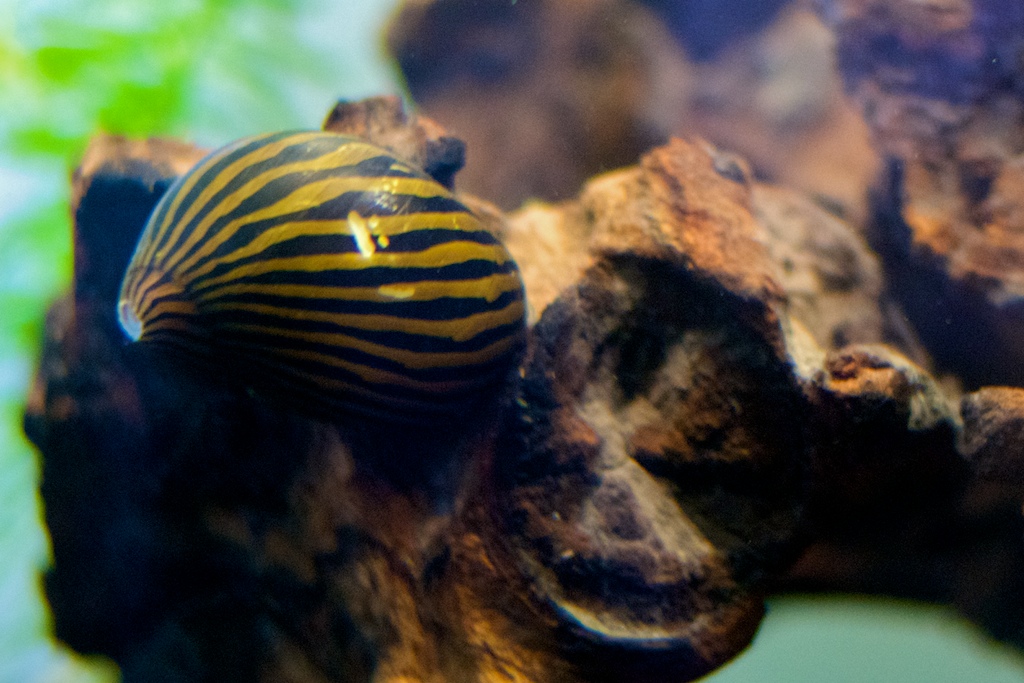 No. 003Nerite snailHerbivore