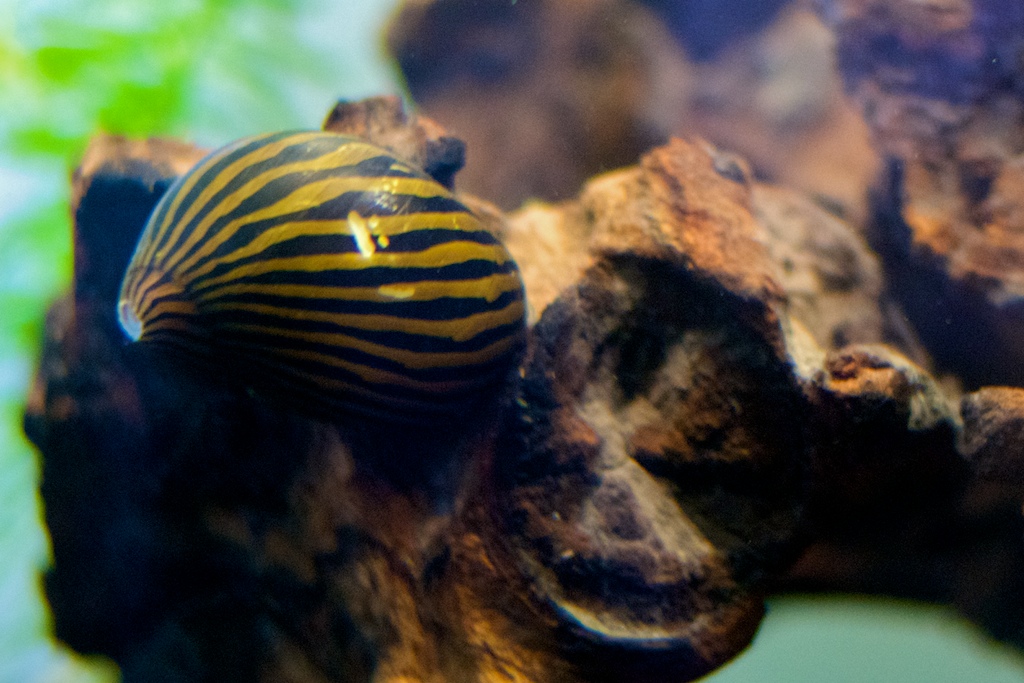
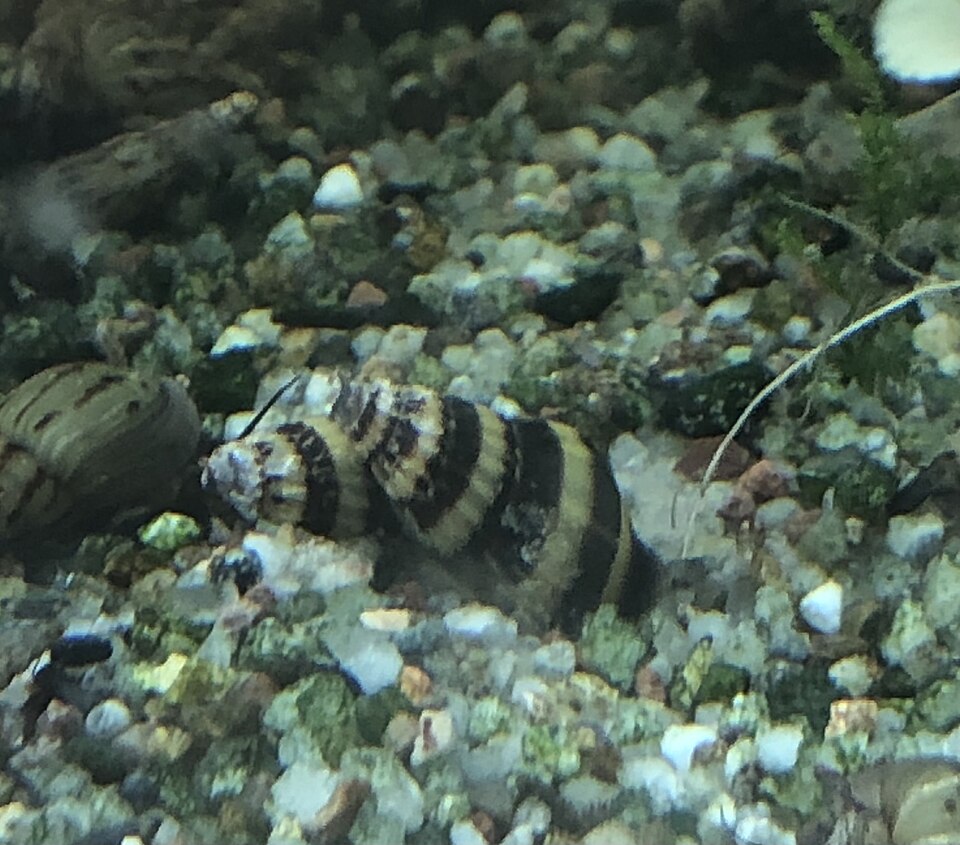
Assassin snail
- Algae grazing
- Low
- Breeding speed
- Not known
- Population growth
- Not known
- Adult size
- 20–35 mm Axis not stated
- Lifespan
- 2–3 years
- Water
- 22–27 °C
- Eats plants
- No
- With shrimp
- Caution
What is an assassin snail?
Aquarium assassin snails are commonly labelled Anentome helena, or the older Clea helena. Research found at least four species within the material studied, and aquarium animals were not securely identified as the true Java species. We therefore treat the trade name as a group, rather than pretending every striped assassin is the same confirmed species.
Scientific scope: Anentome (aquarium assassin-snail complex)
Quick stats
Water
- Water temperature
- 22–27 °C
- pH
- 6.8–8 pH
Tank mates
- With shrimp
- Caution Reports conflict; do not promise a shrimp-safe tank.
- With fish
- Caution
Home
- Starting tank
- 20 litres For 1–2 assassins in a mature, filtered tank with suitable substrate. A conservative starting recommendation, not a biological minimum; other livestock may need more space.
- Secure lid
- Yes
Habits
- Lifespan
- 2–3 years
- Active time
- Night
How big do they get?
The identification key reports adults at about 20–35 mm, without naming a measurement axis. Aquarium Co-Op gives up to 25 mm shell length, while The Shrimp Farm gives about 13 mm. We use the identification key as a reference, not a guaranteed size for every trade animal. Do not compare its figure directly with a measured shell width.
- Adult shell size
- 20–35 mm (Axis not stated) Reference adult size; the key does not state an axis. Aquarium size estimates differ. Fact source
Sources and scope
Australian freshwater molluscs identification key, Anentome helena account. Other estimates: https://www.aquariumcoop.com/blogs/aquarium/assassin-snail and https://www.theshrimpfarm.com/posts/assassin-snail-care/ .
Checked 2026-11-02
How long do they live?
A useful aquarium estimate is 2–3 years, as given by Splashy Fish. Treat it as a care-planning estimate: some individuals live longer, and feeding and water conditions affect survival.
- Lifespan
- 2–3 years Typical aquarium estimate in retailer guidance; individual lifespan depends on care and may be longer. Fact source
Sources and scope
Splashy Fish, assassin-snail care; aquarium lifespan and hatching estimates, not controlled limits.
Checked 2026-11-01
What do they eat?
They hunt other snails and scavenge animal material. Laboratory work found individual differences in prey choice. Maintain a feeding plan after the unwanted snails have gone; do not treat a predator as disposable aquarium equipment.
- Diet type
- Carnivore Predator and scavenger of animal food. Fact source
Sources and scope
Berkhout and Morozov (2022), laboratory predation study; experimental conditions are not stocking advice.
Checked 2026-11-01
Do they eat plants?
They are not kept as plant eaters. The cited husbandry account describes animal-based feeding. Damage to a plant should be investigated rather than attributed to an assassin simply because it was nearby.
- Plant eating
- No Not expected to graze plants: an inference from the described carnivorous feeding, not a guarantee against disturbance. Fact source
Sources and scope
Neale Monks (2009), Assassin Snails in the Aquarium; older husbandry account.
Checked 2026-11-01
Do they eat algae or clean the tank?
No: do not buy one to graze algae. Its feeding role is predatory and scavenging. It still produces waste and does not replace filter care or water changes.
- Algae role
- Low Not an algae-control animal. Fact source
Sources and scope
Fishkeeping.co.uk assassin-snail care sheet; practical ranges and reported shrimp risk.
Checked 2026-11-01
What eats them?
Avoid pufferfish and snail-eating loaches. An assassin’s ability to hunt other snails does not protect it from fish that eat snails.
- Predators
- Pufferfish and snail-eating loaches. Being a predator does not protect an assassin from fish that eat snails. Fact source
Sources and scope
Aquarium Co-Op, assassin-snail care; practical feeding, predator and mineral guidance.
Checked 2026-11-01
Are they safe with shrimp, fish and other snails?
Do assassin snails eat shrimp?
Do not promise shrimp safety. An older expert account calls them harmless to shrimp, while the Fishkeeping.co.uk care sheet records occasional attacks. These reports do not quantify a reliable risk. Our precautionary advice is to keep them out of a shrimp breeding tank if losing shrimp would be unacceptable.
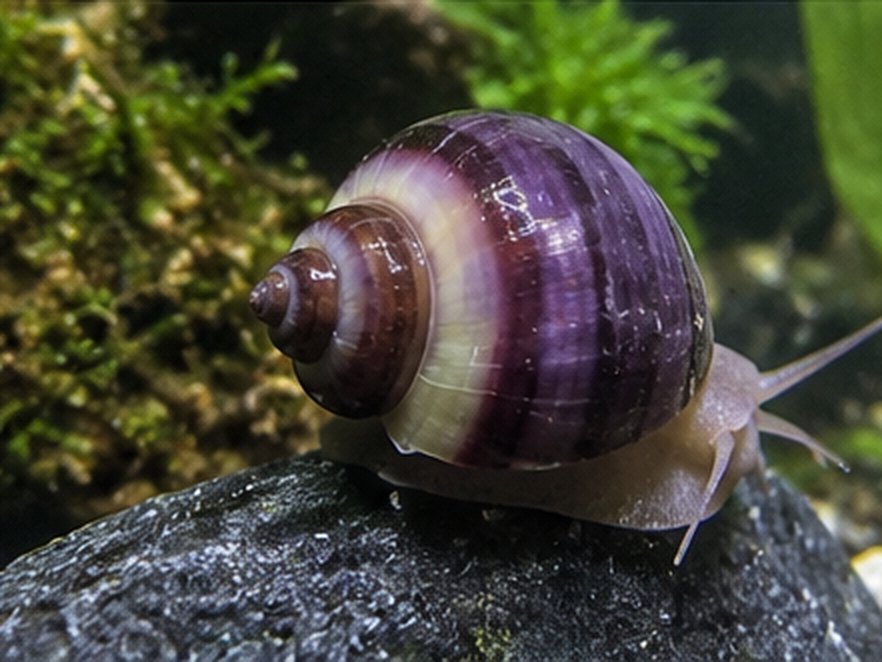
Other snails are an intended prey group. Do not assume a large mystery or nerite snail is guaranteed safe.
- With shrimp
- Caution Reports conflict; do not promise a shrimp-safe tank. Fact source
- With fish
- Caution Peaceful compatible fish only; snail-eating fish remain a risk. Fact source
- With other snails
- No Other ornamental snails can be prey. Fact source
Sources and scope
Fishkeeping.co.uk assassin-snail care sheet; practical ranges and reported shrimp risk. Conflicting account: Neale Monks (2009), https://www.wetwebmedia.com/ca/volume_6/volume_6_4/clea.html . The separation advice is a precautionary editorial inference, not a measured predation rate.
Checked 2026-11-01
How many per tank?
For 1–2 assassins, use 20 litres or more as a starting recommendation, rounding The Shrimp Farm’s 5 US gallons (about 19 litres) upwards. Aquarium Co-Op suggests a smaller 2-US-gallon setup for one; our 20-litre recommendation gives a more conservative starting point. The aquarium needs an established filter, stable water and substrate they can enter. Other livestock and a population of prey snails may require a larger tank.
- Starting tank volume with conditions
- 20 litres For 1–2 assassins in a mature, filtered tank with suitable substrate. A conservative starting recommendation, not a biological minimum; other livestock may need more space. Fact source
Sources and scope
The Shrimp Farm, assassin-snail care; retailer recommendations for trade animals. A practical recommendation with conditions, not a universal biological minimum or litres-per-snail formula. Smaller recommendation: https://www.aquariumcoop.com/blogs/aquarium/assassin-snail .
Checked 2026-11-02
Do they need a heater, or can they live in cold water?
The care-sheet recommendation is 22–27°C. Use a thermometer and a heater if needed to keep conditions stable. Experimental activity at lower or higher temperatures does not make those extremes suitable long-term care targets.
- Recommended water temperature
- 22–27 °C Husbandry guidance for trade animals, not experimentally proven limits for every species. Fact source
Sources and scope
Bodley et al., thermal/salinity tolerance study; survival and activity limits are not recommended care ranges. Practical range is from Fishkeeping.co.uk, linked in the temperature fact. The thermal study is used only to distinguish tolerance from husbandry.
Checked 2026-11-01
What water do they need?
The cited care sheet gives pH 6.8–8.0 and 10–25°dGH. Treat these as husbandry guidance for trade animals, not a validated requirement for every species in the complex. Check the needs of the rest of the aquarium too.
- pH
- 6.8–8 pH Care-sheet range; confirm suitability for the stock and other animals. Fact source
- Hardness guidance with units
- 10–25 °dGH in the cited care sheet. Fact source
Sources and scope
Fishkeeping.co.uk assassin-snail care sheet; practical ranges and reported shrimp risk.
Checked 2026-11-01
How do they breed, and how fast?
Assassins have separate sexes and can reproduce in freshwater. Maidenhead Aquatics describes reproduction as slower than in common nuisance snails, with eggs laid singly. Plan food and space for offspring; slower breeding does not mean the population cannot grow.
- Can reproduce in a freshwater aquarium
- Yes Egg capsules develop into crawling juveniles. Fact source
- Breeding speed
- Not known Reported to reproduce more slowly than common nuisance snails; no fixed rate is supplied. Fact source
- Pair needed
- Yes Separate sexes; a group does not guarantee a particular sex ratio. Fact source
Sources and scope
Maidenhead Aquatics, assassin-snail care; slower reproduction than common nuisance snails.
Checked 2026-11-01
What do the eggs look like, and how long do they take to hatch?
Look for a single egg inside a small, clear, roughly square capsule attached to a firm surface. Published care estimates differ: 3–4 weeks at Splashy Fish versus around two months at The Shrimp Farm. Expect the timing to vary with conditions rather than relying on a fixed hatch date. Juveniles often stay hidden in the substrate after hatching.
- Reproduction type
- Egg laying Fact source
- Hatching time
- Varies Splashy Fish reports about 3–4 weeks; The Shrimp Farm reports around two months. These differing care estimates do not establish one reliable hatch-day range. Fact source
Sources and scope
Splashy Fish, assassin-snail care; aquarium lifespan and hatching estimates, not controlled limits. Contrasting estimate: https://www.theshrimpfarm.com/posts/assassin-snail-care/ (checked 2026-11-01). Egg-capsule structure also described by the identification key, linked beside the reproduction fact.
Checked 2026-11-01
Are they good or bad, and how do I get rid of them?
A predator may reduce other snails, but it adds an animal that also needs care. Investigate excess food and the reason you want population control first. Never move assassins into a pond or waterway: their predation can threaten native snails.
- Population growth concern
- Not known Slower reproduction does not rule out an unwanted population. Plan food and homes for offspring. Fact source
Sources and scope
Strong, Galindo and Kantor (2017), PeerJ 5:e3638; assassin-snail species complex. Population-management recommendation is an editorial inference from the predatory role; no eradication guarantee.
Checked 2026-11-01
Are they nocturnal, and why do they hide?
They are usually described as nocturnal, and burrowing is normal. Food can bring them out of the substrate, so daytime activity is not automatically a problem. A snail missing from view may simply be buried.
- Active time
- Night Usually described as nocturnal; food can prompt emergence from the substrate, so this is not an exclusive timetable. Fact source
- Burrows
- Yes Provide accessible substrate; hidden animals may still be present. Fact source
Sources and scope
Your Local Fish Store, assassin-snail listing; used for its nocturnal behaviour description only. Food-triggered emergence: https://www.aquariumcoop.com/blogs/aquarium/assassin-snail (checked 2026-11-01); burrowing also supported by the study linked beside that fact.
Checked 2026-11-01
Can they survive out of water or climb out?
Use a secure lid as a precaution. We have not established a safe duration out of water for this group. Keep handling brief and do not use an air-exposure claim as a care target.
- Secure lid needed
- Yes A secure lid is our precautionary recommendation, not a measured escape frequency. Fact source
Sources and scope
OATA, freshwater shrimp and snails; general welfare guidance, not species-specific ranges. General containment recommendation; no species-specific survival duration asserted.
Checked 2026-11-01
Is it dead, or just not moving?
Consider burrowing and normal rest, but investigate unusual inactivity. Test water and temperature and seek experienced help if behaviour changes persist. An unmoving snail is not, by itself, a confirmed dead snail.
Sources and scope
OATA, freshwater shrimp and snails; general welfare guidance, not species-specific ranges. General welfare triage; burrowing is supported by the laboratory study in the activity section.
Checked 2026-11-01
Why is the shell damaged, and do they need calcium?
Yes, calcium is needed for shell growth. Check hardness and pH before adding supplements; needing calcium does not mean every aquarium needs a separate dose. Investigate deteriorating shells alongside water quality and feeding.
- Calcium required
- Yes Needed for shell growth. Test water hardness before deciding whether supplements are necessary. Fact source
Sources and scope
The Shrimp Farm, assassin-snail care; retailer recommendations for trade animals.
Checked 2026-11-01
About this identification
Strong, Galindo and Kantor (2017), PeerJ 5:e3638; assassin-snail species complex.
Identification reference · checked 2026-11-01
Keep them contained: never release aquarium snails or eggs into the wild.
Meet another snail
 No. 001Mystery snailOmnivore