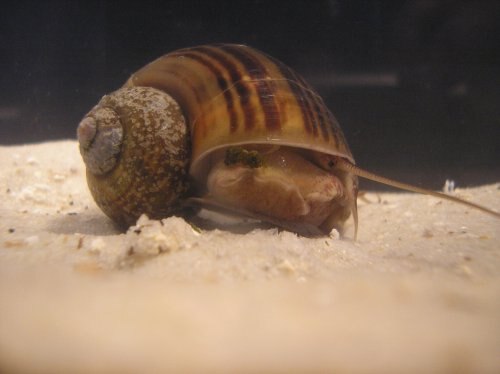
Malaysian trumpet snail
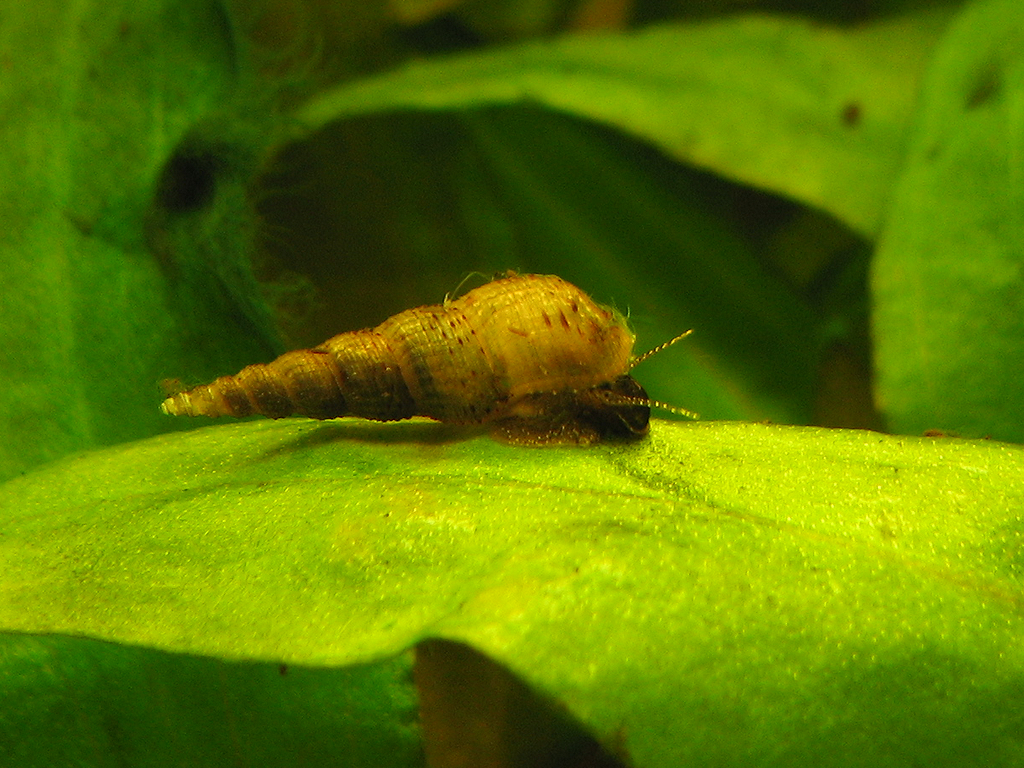
- Algae grazing
- Some
- Breeding speed
- High
- Population growth
- High
- Adult size
- 25–38 mm Axis not stated
- Lifespan
- 1–3 years
- Water
- 21–26 °C
- Eats plants
- No
- With shrimp
- Yes
What is a Malaysian trumpet snail?
Also called the red-rimmed melania or MTS. This entry covers Melanoides tuberculata, not every pointed-shell hitchhiker. Shell colour and markings vary; a cone-shaped shell alone cannot distinguish it from other burrowing snails.
Scientific scope: Melanoides tuberculata
Quick stats
Water
- Water temperature
- 21–26 °C
- pH
- 7–7.5 pH
Tank mates
- With shrimp
- Yes Peaceful shrimp with compatible water needs.
- With fish
- Caution
- With other snails
- Caution
Home
- Starting tank
- 20 litres For a small starting colony in a mature, filtered aquarium; five US gallons rounded up. Population and other livestock matter.
- Secure lid
- Yes
Habits
- Lifespan
- 1–3 years
- Active time
- Night
How big do they get?
The breeder reports typical adults around 25–38 mm. Size varies between populations; this is a planning range, not a maximum for the species.
- Adult shell size
- 25–38 mm (Axis not stated) Breeder’s typical adult range; larger individuals occur. Source does not specify a measurement axis. Fact source
Sources and scope
Aquatic Arts, captive-bred Melanoides tuberculata husbandry.
Checked 2026-11-02
How long do they live?
Plan for roughly 1–3 years. Aquarium Care Basics reports around a year, while the UWI ecological account gives 2.5–3 years. Neither guarantees the remaining life of an adult you receive.
- Lifespan
- 1–3 years Broad planning estimate: aquarium observations around one year; ecological account 2.5–3 years. Fact source
Sources and scope
Janet Joseph, UWI Online Guide (2015), literature synthesis of Melanoides tuberculata ecology and reproduction. Aquarium estimate: https://www.aquariumcarebasics.com/freshwater-snails/malaysian-trumpet-snails/ .
Checked 2026-11-02
What do they eat?
They forage for organic debris, algae and microorganisms. Offer suitable sinking food when needed, but avoid feeding an invisible colony more than it can consume.
- Diet type
- Detritivore Organic debris, microorganisms and algae; also accepts prepared foods. Fact source
Sources and scope
Janet Joseph, UWI Online Guide (2015), literature synthesis of Melanoides tuberculata ecology and reproduction.
Checked 2026-11-02
Do they eat plants?
Healthy plants are normally safe. Decaying leaves are food, so finding a snail on damaged foliage does not establish that it caused the damage.
- Plant eating
- No Healthy plants normally left intact. Fact source
Sources and scope
Aquatic Arts, captive-bred Melanoides tuberculata husbandry.
Checked 2026-11-02
Do they eat algae or clean the tank?
They eat some algae and biofilm, but also produce waste. Keep up normal maintenance rather than expecting a colony to make the tank self-cleaning.
- Algae role
- Some Some surface grazing, alongside detritus feeding. Fact source
Sources and scope
Aquatic Arts, captive-bred Melanoides tuberculata husbandry.
Checked 2026-11-02
What eats them?
Assassin snails readily prey on trumpet snails. Avoid adding a predator merely to solve overfeeding; it creates another animal with its own care needs.
- Predators
- Assassin snails and snail-eating fish. Fact source
Sources and scope
Aquarium Co-Op, assassin-snail predation, including trumpet snails and larger rabbit snails.
Checked 2026-11-02
Are they safe with shrimp, fish and other snails?
The Shrimp Farm keeps MTS alongside its shrimp, sharing feeding areas. Peaceful fish and snails can also work; exclude predators and check that water requirements overlap.
- With shrimp
- Yes Peaceful shrimp with compatible water needs. Fact source
- With fish
- Caution Choose non-predatory community fish. Fact source
- With other snails
- Caution Peaceful snails can coexist; assassins prey on trumpet snails. Fact source
Sources and scope
The Shrimp Farm, observations of trumpet snails in its shrimp tanks. Other companions: Aquarium Care Basics, linked in fish fact.
Checked 2026-11-02
How many per tank?
A 20-litre or larger, mature, filtered tank is a starting point for a small colony. Reassess the load as it grows; a water-volume figure cannot set a permanent snail count.
- Starting tank volume with conditions
- 20 litres For a small starting colony in a mature, filtered aquarium; five US gallons rounded up. Population and other livestock matter. Fact source
Sources and scope
Aquarium Care Basics, first-hand aquarium trumpet-snail observations and care guidance.
Checked 2026-11-02
Do they need a heater, or can they live in cold water?
21–26°C is the keeper’s community-tank band, rounded from Fahrenheit. The breeder gives 22–30°C. Use a heater where needed for stable conditions; wild survival records are not care targets.
- Recommended water temperature
- 21–26 °C 70–78°F rounded to whole Celsius degrees. Not the full survival range. Fact source
Sources and scope
Aquarium Care Basics, first-hand aquarium trumpet-snail observations and care guidance. Breeder recommendation: Aquatic Arts, linked in size fact.
Checked 2026-11-02
What water do they need?
Start with pH 7.0–7.5 and suitable mineral content. The breeder gives KH 2–12°dKH; KH is buffering capacity, not a substitute for checking general hardness or calcium.
- pH
- 7–7.5 pH Practical aquarium recommendation, not a species tolerance boundary. Fact source
- Hardness guidance with units
- KH 2–12°dKH (breeder guidance); keep adequate calcium for shell growth. Fact source
Sources and scope
Aquarium Care Basics, first-hand aquarium trumpet-snail observations and care guidance. KH: Aquatic Arts, linked in hardness fact.
Checked 2026-11-02
How do they breed, and how fast?
One female can start a colony through parthenogenesis, without a mate. Young develop internally and are released alive; sexual reproduction also occurs in this species.
- Can reproduce in a freshwater aquarium
- Yes Fact source
- Breeding speed
- High Prolific when food and conditions permit. Fact source
- Pair needed
- No Parthenogenesis occurs: a female can reproduce without mating. Sexual populations also exist. Fact source
Sources and scope
Janet Joseph, UWI Online Guide (2015), literature synthesis of Melanoides tuberculata ecology and reproduction.
Checked 2026-11-02
What do the eggs look like, and how long do they take to hatch?
You will not find an external MTS egg clutch to incubate. The female broods her young internally, so a glass-mounted jelly patch belongs to another kind of snail.
- Reproduction type
- Livebearing Fact source
- Hatching time
- Not applicable Young develop in a brood pouch; no external egg clutch to monitor. Fact source
Sources and scope
Janet Joseph, UWI Online Guide (2015), literature synthesis of Melanoides tuberculata ecology and reproduction.
Checked 2026-11-02
Are they good or bad, and how do I get rid of them?
Whether they are welcome depends on the tank. If numbers rise sharply, reduce excess feeding, remove leftovers and manually remove unwanted snails. Do not release them outdoors or use another animal as an instant fix.
- Population growth concern
- High Surplus food can support rapid population growth. Fact source
Sources and scope
The Shrimp Farm, observations of trumpet snails in its shrimp tanks. No release: general aquarium welfare advice in OATA.
Checked 2026-11-02
Are they nocturnal, and why do they hide?
They spend much of the day in the substrate and often emerge after dark. A few appearing for daytime food is normal; investigate water quality if behaviour changes across the colony.
- Active time
- Night Mainly nocturnal; food can draw them out during the day. Fact source
- Burrows
- Yes Fact source
Sources and scope
The Shrimp Farm, observations of trumpet snails in its shrimp tanks. Nocturnal pattern: UWI ecology, linked in activity fact.
Checked 2026-11-02
Can they survive out of water or climb out?
Keep the aquarium covered and protect strong filter intakes. Small snails can become trapped at an unguarded intake.
- Secure lid needed
- Yes Use a covered aquarium and protect filter intakes. Fact source
Sources and scope
Aquarium Care Basics, first-hand aquarium trumpet-snail observations and care guidance.
Checked 2026-11-02
Is it dead, or just not moving?
A snail hidden beneath the substrate may be alive and feeding. For a visible motionless animal, check water and signs of decay; do not dig up the whole tank just to count the colony.
Sources and scope
Pro Shrimp, keeper guidance on inactivity; stillness alone does not establish death. Burrowing behaviour: The Shrimp Farm, linked in activity answer.
Checked 2026-11-02
Why is the shell damaged, and do they need calcium?
Calcium supports new shell growth. Check food and water chemistry when damage develops, and avoid abrupt mineral or pH changes.
- Calcium required
- Yes Fact source
Sources and scope
Aquarium Care Basics, first-hand aquarium trumpet-snail observations and care guidance.
Checked 2026-11-02
About this identification
Janet Joseph, UWI Online Guide (2015), literature synthesis of Melanoides tuberculata ecology and reproduction.
Identification reference · checked 2026-11-02
Keep them contained: never release aquarium snails or eggs into the wild.
Meet another snail
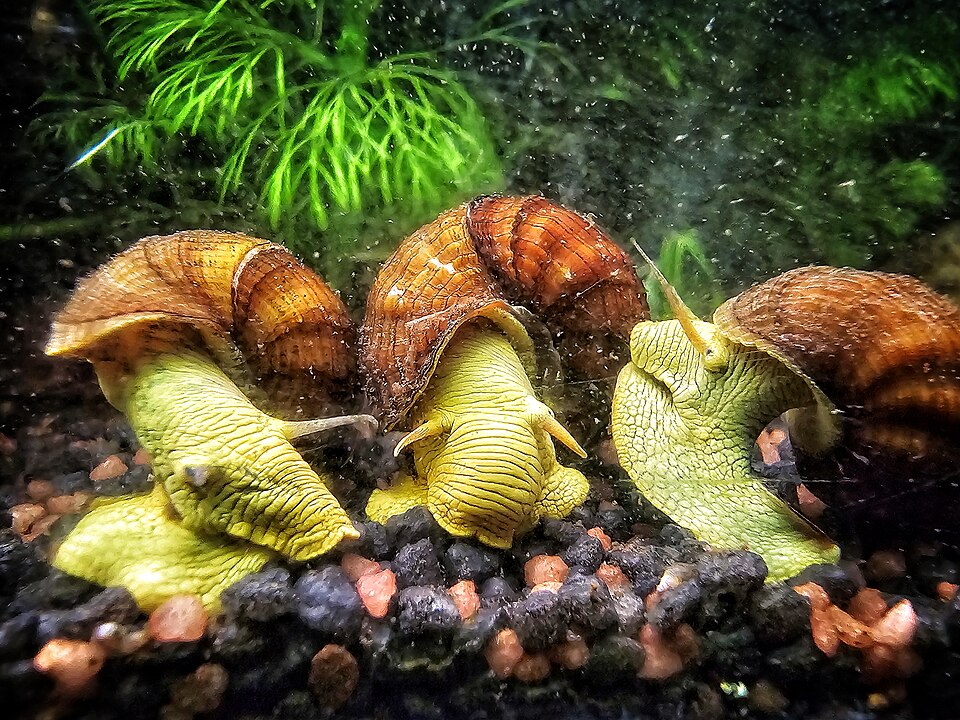 No. 006Rabbit snailOmnivore