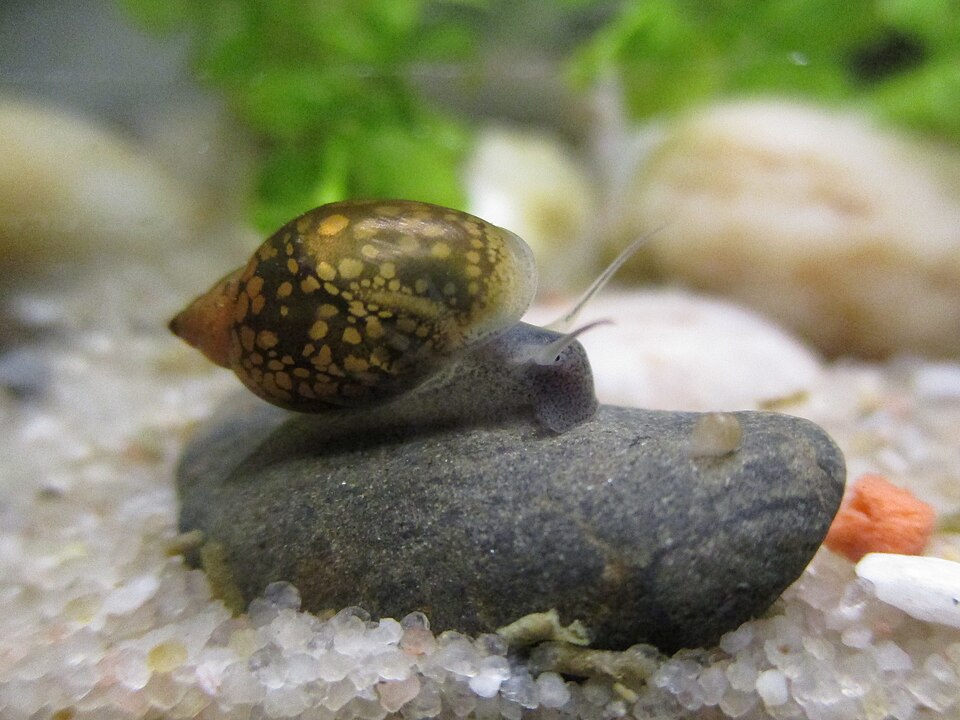
Bladder snail
- Algae grazing
- Some
- Breeding speed
- High
- Population growth
- High
- Adult size
- 7–12 mm Shell height
- Lifespan
- 0.5–1.1 years
- Water
- 17–27 °C
- Eats plants
- No
- With shrimp
- Yes
What is a bladder snail?
This page covers the acute bladder snail, Physella acuta, also called Physa acuta in research. Its pointed, left-opening shell and fine tentacles help separate it from familiar pond snails. Other bladder-snail species exist, including Physa fontinalis: a small hitchhiker is not automatically P. acuta.
Scientific scope: Physella acuta
Quick stats
Water
- Water temperature
- 17–27 °C
- pH
- 7–8 pH
Tank mates
- With shrimp
- Yes A peaceful scavenger; use compatible dwarf shrimp and water conditions.
- With fish
- Caution
- With other snails
- Caution
Home
- Starting tank
- 10 litres For a small snail group, using general OATA guidance rather than a measured bladder-snail minimum. Use a stable, maintained aquarium; fish or population growth may require more space.
- Secure lid
- Yes
Habits
- Lifespan
- 0.5–1.1 years
- Active time
- Varies
How big do they get?
The British key gives 7–12 mm shell height; USGS records examples up to 16 mm. Measure from the shell tip to its base, not along the extended foot.
- Adult shell size
- 7–12 mm (Shell height) British identification-guide range. Larger examples are reported: USGS gives up to 16 mm. Shell height, not body length. Fact source
Sources and scope
Conchological Society of Great Britain and Ireland, Physidae identification key. Larger maximum: https://nas.er.usgs.gov/queries/factsheet.aspx?SpeciesID=1025
Checked 2026-11-01
How long do they live?
The research literature reports roughly 6–13 months at different temperatures. That is a useful planning estimate, not a maximum lifespan or a reason to warm the water to speed development.
- Lifespan
- 0.5–1.1 years Roughly 6–13 months: rounded conversion of 190–400 days reported in the research literature at different temperatures; not a universal maximum. Fact source
Sources and scope
Raynal, Schwanz and Bonduriansky (2025), temperature and Physa acuta development; laboratory estimates are not aquarium guarantees.
Checked 2026-11-01
What do they eat?
They graze biofilm and algae and scavenge decaying material or spare food. Check feeding in a deliberately maintained colony, but avoid a constant surplus.
- Diet type
- Omnivore Algae, biofilm, decaying material and suitable leftover foods. Fact source
Sources and scope
Aquatic Arts, captive-bred bladder snails. Used for feeding and pH only; its erroneous livebearing and size statements are rejected.
Checked 2026-11-01
Do they eat plants?
Healthy plants are normally left intact. A snail on a damaged leaf may be eating tissue that was already dying.
- Plant eating
- No Normally leaves healthy plants intact while consuming decaying tissue. Fact source
Sources and scope
Aquatic Arts, captive-bred bladder snails. Used for feeding and pH only; its erroneous livebearing and size statements are rejected.
Checked 2026-11-01
Do they eat algae or clean the tank?
They contribute some surface grazing. They also produce waste, so keep maintaining the filter and changing water.
- Algae role
- Some Some grazing, with no claim to replace aquarium cleaning. Fact source
Sources and scope
Aquatic Arts, captive-bred bladder snails. Used for feeding and pH only; its erroneous livebearing and size statements are rejected.
Checked 2026-11-01
What eats them?
Puffers and snail-eating loaches readily take small snails. Adding a predator introduces another animal with its own requirements. Keep assassin snails separate: they can prey on these snails.
- Predators
- Pufferfish, snail-eating loaches and assassin snails. Fact source
Sources and scope
Aquatic Arts, captive-bred bladder snails. Used for feeding and pH only; its erroneous livebearing and size statements are rejected. Assassin predation: https://www.aquariumcoop.com/blogs/aquarium/assassin-snail (checked 2026-11-02).
Checked 2026-11-02
Are they safe with shrimp, fish and other snails?
Their scavenging habits suit peaceful communities and dwarf shrimp. Check conditions and exclude animals that eat or harass snails; compatibility works in both directions.
- With shrimp
- Yes A peaceful scavenger; use compatible dwarf shrimp and water conditions. Fact source
- With fish
- Caution Avoid snail-eating fish and harassment. Fact source
- With other snails
- Caution Peaceful companions only. Do not assume predatory snails are safe. Fact source
Sources and scope
Aquatic Arts, captive-bred bladder snails. Used for feeding and pH only; its erroneous livebearing and size statements are rejected.
Checked 2026-11-01
How many per tank?
OATA suggests at least 10 litres for a small snail group. This is general snail guidance, not a measured minimum for bladder snails. Use an established aquarium and allow more room for fish or a growing colony.
- Starting tank volume with conditions
- 10 litres For a small snail group, using general OATA guidance rather than a measured bladder-snail minimum. Use a stable, maintained aquarium; fish or population growth may require more space. Fact source
Sources and scope
OATA, general freshwater snail welfare; not a measured species optimum.
Checked 2026-11-02
Do they need a heater, or can they live in cold water?
17–27°C is the general aquarium guidance used here. A heater is needed only if the actual tank cannot stay suitable. Laboratory temperature responses do not establish an optimum for your aquarium.
- Recommended water temperature
- 17–27 °C General aquarium-snail care band, also within the breeder's 17–29°C guidance. Not the species' full tolerance range. Fact source
Sources and scope
OATA, general freshwater snail welfare; not a measured species optimum.
Checked 2026-11-01
What water do they need?
The breeder recommends pH 7.0–8.0. Use the general GH/KH guidance below as a starting reference, then check your water and other animals. Wild tolerance of poor conditions is not care advice.
- pH
- 7–8 pH Breeder husbandry recommendation. Fact source
- Hardness guidance with units
- General starting guidance: GH 4–18 °dGH; KH 3–15 °dKH. Not a measured P. acuta optimum. Avoid unmineralised water and review shell condition. Fact source
Sources and scope
Aquatic Arts, captive-bred bladder snails. Used for feeding and pH only; its erroneous livebearing and size statements are rejected.
Checked 2026-11-01
How do they breed, and how fast?
One snail can reproduce. They prefer mating when partners are available but can self-fertilise. Rapid maturity and repeated egg production explain why a few hitchhikers can turn into a colony.
- Can reproduce in a freshwater aquarium
- Yes Fact source
- Breeding speed
- High Readily forms successive generations; food and temperature change output. Fact source
- Pair needed
- No Self-fertilisation is possible; a lone snail can found a population. Fact source
Sources and scope
Freshwater Gastropods of North America, Physa acuta account by the researchers; reproduction and self-fertilisation.
Checked 2026-11-01
What do the eggs look like, and how long do they take to hatch?
They lay jelly-like egg masses underwater, rather than giving birth to live young. The research literature uses an incubation estimate of 4–15 days, with temperature affecting development.
- Reproduction type
- Egg laying Submerged gelatinous egg masses; not livebearing. Fact source
- Hatching time
- 4–15 days Research literature incubation estimate; temperature-dependent, not a deadline for every aquarium clutch. Fact source
Sources and scope
Raynal, Schwanz and Bonduriansky (2025), temperature and Physa acuta development; laboratory estimates are not aquarium guarantees.
Checked 2026-11-01
Are they good or bad, and how do I get rid of them?
A rising count is a reason to inspect food and waste, not proof of a dirty tank. Reduce leftovers, collect surplus snails and check incoming plants. Never release animals or eggs into outdoor water.
- Population growth concern
- High High population-growth concern when plentiful food supports reproduction; not a claim that the animal is inherently harmful. Fact source
Sources and scope
Freshwater Gastropods of North America, Physa acuta account by the researchers; reproduction and self-fertilisation. Management advice is an editorial inference from the documented reproduction; no eradication guarantee.
Checked 2026-11-01
Are they nocturnal, and why do they hide?
Expect movement to change with food and disturbance. Research documents escape responses to predators. We have not established a universal nocturnal schedule or a reliable habitual-burrowing claim.
- Active time
- Varies Food, disturbance and predator cues change activity; no fixed day/night timetable is established by the sources used here. Fact source
- Burrows
- Not known The breeder describes substrate sifting, which does not establish habitual burial. Surface grazing is the useful expectation; a firm burrowing claim remains unverified. Fact source
Sources and scope
Physa acuta predator-cue study (2025); observed crawl-out defence.
Checked 2026-11-01
Can they survive out of water or climb out?
They can crawl above the water when threatened. Keep a lid with safe ventilation, and investigate water or harassment if many snails suddenly leave it. Do not use air exposure as a care target.
- Secure lid needed
- Yes Precautionary containment: crawl-out behaviour is documented. Retain ventilation and access to air. Fact source
Sources and scope
Physa acuta predator-cue study (2025); observed crawl-out defence.
Checked 2026-11-01
Is it dead, or just not moving?
Check water, temperature and recent changes when movement stops. Stillness alone is not a diagnosis. Inspect the animal gently and remove confirmed decomposing remains promptly.
Sources and scope
OATA, general freshwater snail welfare; not a measured species optimum. General welfare triage; not a species-specific diagnostic test.
Checked 2026-11-01
Why is the shell damaged, and do they need calcium?
Calcium matters: research found unusually thin shells in very soft, unsupplemented water. Test before dosing. New damage deserves a review of minerals, pH and food rather than a blind additive.
- Calcium required
- Yes Shell growth needs calcium. General hardness is a useful check, not a direct calcium measurement. Fact source
Sources and scope
Meuthen and Reinhold (2023), Physella acuta shell study; very soft unsupplemented water produced thin shells.
Checked 2026-11-01
About this identification
Conchological Society of Great Britain and Ireland, Physidae identification key.
Identification reference · checked 2026-11-01
Keep them contained: never release aquarium snails or eggs into the wild.
Meet another snail
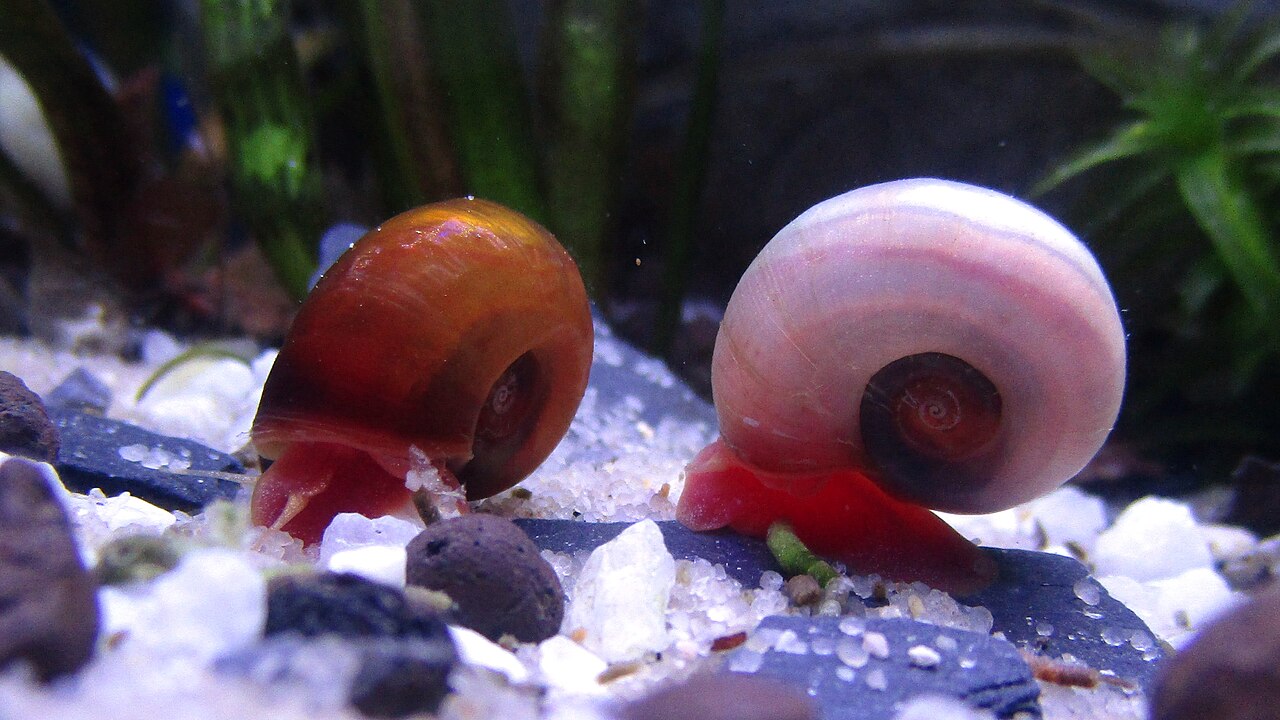 No. 004Ramshorn snailOmnivore