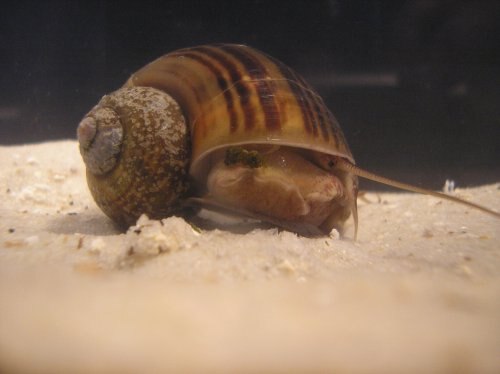
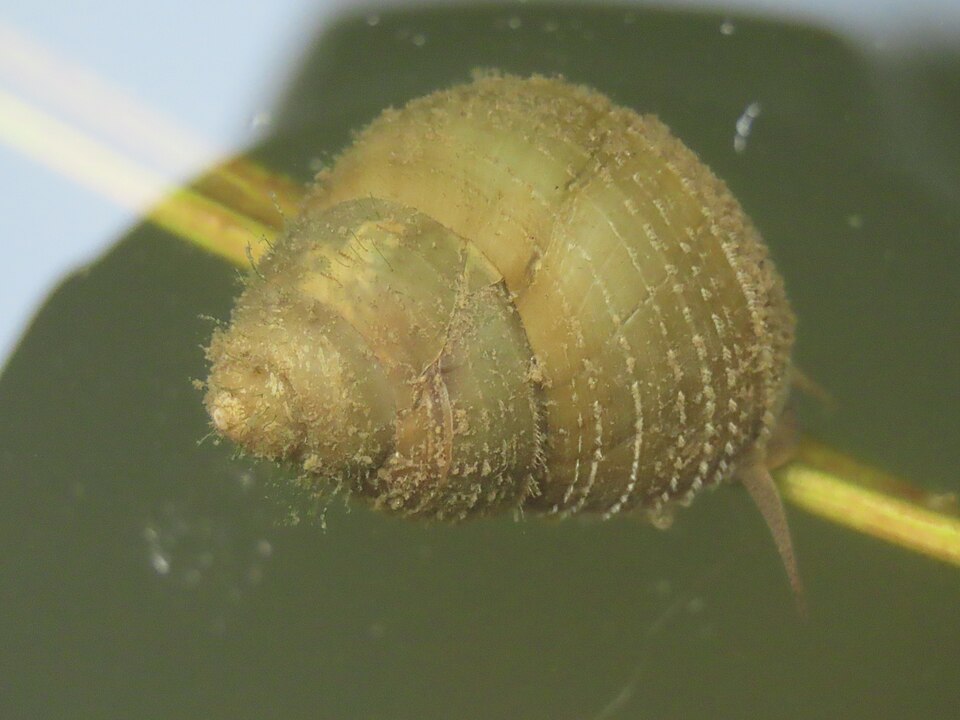
Pond snail
- Algae grazing
- Some
- Breeding speed
- High
- Population growth
- High
- Adult size
- 35–50 mm Shell height
- Lifespan
- 1.5–3 years
- Water
- 18–22 °C
- Eats plants
- Yes
- With shrimp
- Caution
What is a pond snail?
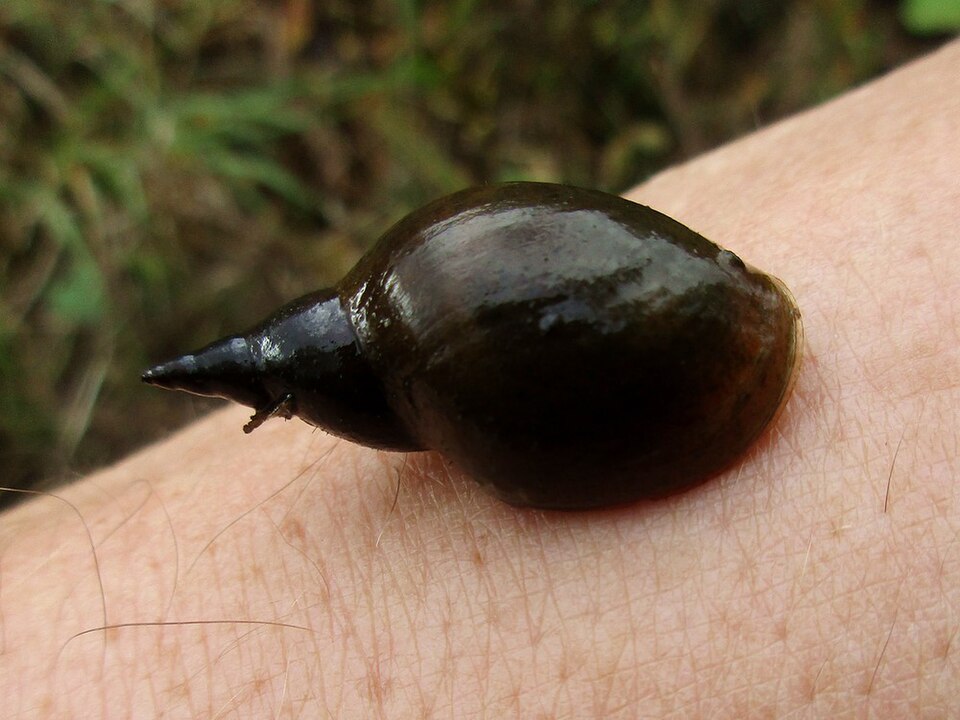
This guide means the great pond snail, Lymnaea stagnalis. “Pond snail” also covers smaller Lymnaeidae and simply snails found in ponds; their care is not interchangeable. This species has a tall, right-handed shell and no trapdoor. It is not a bladder snail. The photograph shows the shell of a living wild animal, not shop stock.
Scientific scope: Lymnaea stagnalis
Quick stats
Water
- Water temperature
- 18–22 °C
- pH
- 7–8.5 pH
Tank mates
- With shrimp
- Caution Peaceful shrimp with overlapping cool-water needs; monitor feeding and vulnerable livestock.
- With fish
- Caution
- With other snails
- Caution
Home
- Starting tank
- 20 litres Starting suggestion for one adult around 5 cm in a mature filtered tank, applying OATA larger-snail guidance. Add room for offspring and companions.
- Secure lid
- Yes
Habits
- Lifespan
- 1.5–3 years
- Active time
- Day and night
How big do they get?
Expect 35–50 mm shell height and roughly 18–28 mm width. The long spire and large final whorl help distinguish an adult from smaller hitchhikers. Check the bladder snail entry in the Index before naming a tiny newcomer.
- Adult shell size
- 35–50 mm (Shell height) Fact source
Sources and scope
Conchological Society of Great Britain and Ireland, Lymnaea stagnalis identification and measured shell axes.
Checked 2026-11-02
How long do they live?
The research literature gives approximately 1.5–3 years. That is a planning estimate, not a promise for an unknown-age animal; temperature, food and water quality affect its life.
- Lifespan
- 1.5–3 years Research background estimate; wild and aquarium lifespans differ. Fact source
Sources and scope
Transcriptome analysis provides genome annotation and expression profiles in the central nervous system of Lymnaea stagnalis at different ages (2021); background lifespan estimate.
Checked 2026-11-02
What do they eat?
Offer washed leafy vegetables and suitable sinking food, alongside natural grazing. They also scavenge animal material. Give small portions and remove leftovers; an adaptable appetite does not make polluted water safe.
- Diet type
- Omnivore Mostly vegetation, algae and detritus; also scavenges animal food. Fact source
Sources and scope
Shrimp and Snail Breeder, Michael, pond-snail feeding and plant damage. Extreme survival ranges and very small unfiltered containers are not adopted here.
Checked 2026-11-02
Do they eat plants?
Yes. Great pond snails can rasp holes in soft living leaves. Extra vegetables may distract them, but do not guarantee the safety of a planted display.
- Plant eating
- Yes Soft living leaves can be damaged even with other food available. Fact source
Sources and scope
Shrimp and Snail Breeder, Michael, pond-snail feeding and plant damage. Extreme survival ranges and very small unfiltered containers are not adopted here.
Checked 2026-11-02
Do they eat algae or clean the tank?
They eat algae as part of a varied diet. They will not reliably solve blanket weed or replace maintenance, and their appetite for plants matters when choosing them for a pond or aquarium.
- Algae role
- Some Grazes algae alongside other food; no blanket-weed clearance promise. Fact source
Sources and scope
Fodor et al. (2020), eLife 9:e56962, natural history of Lymnaea stagnalis.
Checked 2026-11-02
What eats them?
Keep them away from puffers, snail-eating loaches, crayfish and assassin snails. A larger shell is not reliable protection from an assassin group.
- Predators
- Puffers, snail-eating loaches, crayfish and assassin snails. Fish: OATA; crayfish: pond keeper account. Fact source
Sources and scope
Aquarium Co-Op, assassin-snail predation; size does not reliably protect other snails. Other predators: OATA and the pond keeper account linked in the short facts.
Checked 2026-11-02
Are they safe with shrimp, fish and other snails?
Choose peaceful companions that suit 18–22°C and the same mineral-rich water. Avoid predators and watch vulnerable animals during feeding; do not assume a tropical community is suitable because the snail came from freshwater.
- With shrimp
- Caution Peaceful shrimp with overlapping cool-water needs; monitor feeding and vulnerable livestock. Fact source
- With fish
- Caution Avoid snail-eating fish; companions must suit the cool setup. Fact source
- With other snails
- Caution Exclude assassins; provide enough food and room for peaceful species. Fact source
Sources and scope
OATA general freshwater snail welfare; any application to a particular entry is stated explicitly. Temperature: OECD culture conditions, linked in the temperature answer. This is cautious stocking advice, not proof of universal shrimp safety.
Checked 2026-11-02
How many per tank?
Start with 20 litres for one adult around 5 cm, established filtration and space to graze. This applies OATA’s larger-snail baseline; it is not a tested species minimum. Increase space for companions and a growing colony.
- Starting tank volume with conditions
- 20 litres Starting suggestion for one adult around 5 cm in a mature filtered tank, applying OATA larger-snail guidance. Add room for offspring and companions. Fact source
Sources and scope
OATA general freshwater snail welfare; any application to a particular entry is stated explicitly.
Checked 2026-11-02
Do they need a heater, or can they live in cold water?
18–22°C follows the species’ indoor culture guidance. A heater is unnecessary if the water stays in that band. Outdoor survival limits are different from comfortable indoor care targets.
- Recommended water temperature
- 18–22 °C Indoor culture band, not the full outdoor survival range. Fact source
Sources and scope
OECD Test 243 (2016), Annex 2, pages 19–21: culture husbandry, not the chemical-exposure protocol or aquarium stocking rules.
Checked 2026-11-02
What water do they need?
The culture protocol uses pH 7.0–8.5 and total hardness near 250 mg/L as CaCO₃, about 14°dGH. Test your water before adding minerals, and keep changes gradual.
- pH
- 7–8.5 pH Culture guidance for this species. Fact source
- Hardness guidance with units
- About 250 mg/L as CaCO₃ total hardness in the culture protocol (roughly 14°dGH). Fact source
Sources and scope
OECD Test 243 (2016), Annex 2, pages 19–21: culture husbandry, not the chemical-exposure protocol or aquarium stocking rules.
Checked 2026-11-02
How do they breed, and how fast?
These hermaphrodites can self-fertilise, although mating is preferred. One arrival can therefore start a colony; repeated clutches make population growth rapid when conditions are favourable.
- Can reproduce in a freshwater aquarium
- Yes Fact source
- Breeding speed
- High Repeated large clutches in favourable conditions. Fact source
- Pair needed
- No Can self-fertilise; normally favours mating with another individual. Fact source
Sources and scope
Fodor et al. (2020), eLife 9:e56962, natural history of Lymnaea stagnalis.
Checked 2026-11-02
What do the eggs look like, and how long do they take to hatch?
Look for clear jelly-like masses containing many eggs on submerged surfaces. Hatching can begin at about 10 days at 20°C; 10–12 days is a useful warm-culture estimate, not a deadline in a cold pond.
- Reproduction type
- Egg laying Fact source
- Hatching time
- 10–12 days Around 20°C; eLife describes 11–12 days. Cooler water can delay hatching. Fact source
Sources and scope
OECD Test 243 (2016), Annex 2, pages 19–21: culture husbandry, not the chemical-exposure protocol or aquarium stocking rules. Jelly masses and 11–12-day development: eLife natural history review.
Checked 2026-11-02
Are they good or bad, and how do I get rid of them?
They are interesting grazers, but plants and unwanted offspring can become a problem. Reduce surplus food and remove unwanted snails and egg masses manually. Keep aquarium animals out of natural waterways.
- Population growth concern
- High A single snail can establish a growing population. Fact source
Sources and scope
Shrimp and Snail Breeder, Michael, pond-snail feeding and plant damage. Extreme survival ranges and very small unfiltered containers are not adopted here. Population potential: eLife; no release is precautionary aquarium practice.
Checked 2026-11-02
Are they nocturnal, and why do they hide?
They can be active by day or night and show sleep-like rest. A missing snail may be behind plants or décor. The reviewed sources do not establish routine aquarium burrowing.
- Active time
- Day and night No clear day/night rhythm in the cited account. Fact source
- Burrows
- Not known Regular aquarium burrowing was not established by the reviewed species sources; do not count on substrate turning. Fact source
Sources and scope
Fodor et al. (2020), eLife 9:e56962, natural history of Lymnaea stagnalis.
Checked 2026-11-02
Can they survive out of water or climb out?
Use a ventilated lid and leave access to the surface. Young snails can crawl above the water and dry out; air breathing does not make them land snails.
- Secure lid needed
- Yes Ventilated cover with access to the surface for air. Fact source
Sources and scope
OECD Test 243 (2016), Annex 2, pages 19–21: culture husbandry, not the chemical-exposure protocol or aquarium stocking rules.
Checked 2026-11-02
Is it dead, or just not moving?
Stillness alone does not prove death. Check water and recent behaviour; investigate persistent inactivity and remove a clearly decomposing animal promptly. Never pull it from its shell.
Sources and scope
Pro Shrimp, keeper guidance: inactivity alone does not establish death.
Checked 2026-11-02
Why is the shell damaged, and do they need calcium?
Calcium supports shell growth. Review mineral content and food if new damage appears, and investigate unsuitable water before adding supplements blindly.
- Calcium required
- Yes Fact source
Sources and scope
Shrimp and Snail Breeder, Michael, pond-snail feeding and plant damage. Extreme survival ranges and very small unfiltered containers are not adopted here.
Checked 2026-11-02
About this identification
Conchological Society of Great Britain and Ireland, Lymnaea stagnalis identification and measured shell axes.
Identification reference · checked 2026-11-02
Keep them contained: never release aquarium snails or eggs into the wild.