Mystery snail
- Algae grazing
- Some
- Breeding speed
- Not known
- Population growth
- Not known
- Adult size
- 40–50 mm Shell width · varies
- Lifespan
- 1–2 years
- Water
- 21–26 °C
P. diffusa reference; other mystery snails may differ.
- Eats plants
- Sometimes
- With shrimp
- Yes
What is a mystery snail?
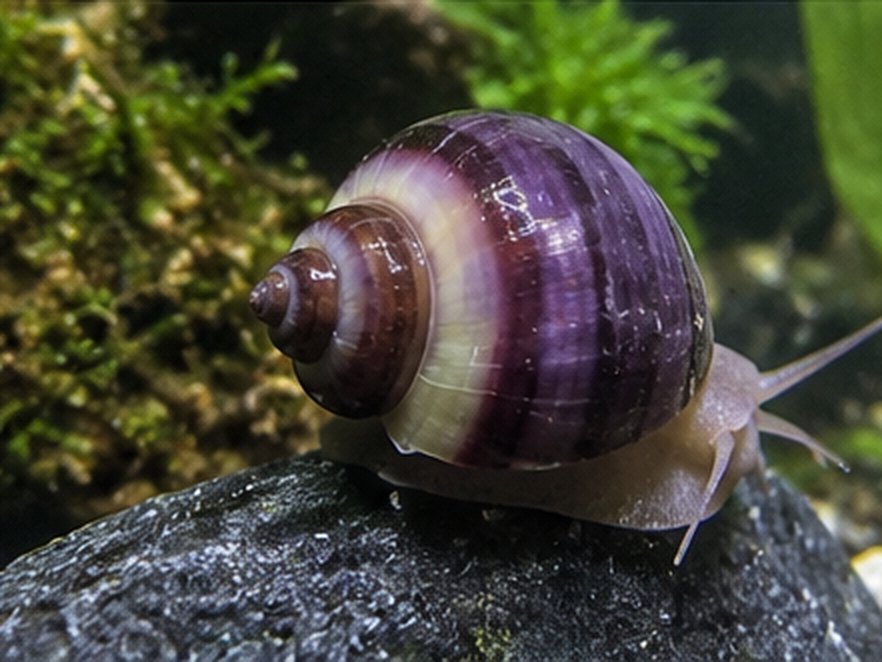
Mystery snail is a trade name, not a reliable species identification. Pomacea diffusa is common in aquariums and is distinct from P. bridgesii. This guide focuses on the smaller aquarium mystery snails described by the sources; it does not cover every apple snail. Our breeding stock has not yet been independently identified to species. Shell colour alone does not settle that question.
Scientific scope: Pomacea (mystery-snail trade group)
Quick stats
Water
- Water temperature
- 21–26 °C
- pH
- 7.6–8.4 pH
Tank mates
- With shrimp
- Yes Peaceful dwarf shrimp with matching water needs.
- With fish
- Caution
- With other snails
- Caution
Home
- Starting tank
- 20 litres Starting recommendation for 1–2 aquarium mystery snails: 5 US gallons (about 19 litres), rounded up to 20 litres. Use a mature filtered tank; other livestock may need more space.
- Secure lid
- Yes
Habits
- Lifespan
- 1–2 years
- Active time
- Varies
How big do they get?
For identified P. diffusa, the species account gives a shell width of 40–50 mm and height of 45–65 mm. Width and height are different measurements. An unidentified apple snail may grow differently; the juvenile size offered for sale is not its adult size.
- Adult shell size
- 40–50 mm (Shell width) — varies P. diffusa reference; other mystery snails may differ. Fact source
How long do they live?
A practical aquarium estimate is 1–2 years, with temperature and care affecting longevity. It is an estimate, not a guarantee for an individual snail.
- Lifespan
- 1–2 years Typical aquarium estimate; temperature and care affect lifespan. Fact source
Sources and scope
Aquarium Co-Op, mystery-snail care; practical husbandry guidance, not controlled limits.
Checked 2026-11-01
What do they eat?
Offer suitable sinking aquarium food and small portions of washed vegetables. Observe what is eaten and remove uneaten food. A planted tank does not automatically provide enough food.
- Diet type
- Omnivore Feed deliberately; grazing alone is insufficient. Fact source
Sources and scope
AppleSnail.net, apple-snail care; species scope matters.
Checked 2026-11-01
Do they eat plants?
Identified P. diffusa generally favours decaying plants and prepared food, but soft vegetation can be eaten. Avoid a blanket “plant safe” promise for every snail sold under an apple- or mystery-snail name.
- Plant eating
- Sometimes P. diffusa usually favours decaying material; other apple snails can be destructive plant eaters. Fact source
Do they eat algae or clean the tank?
They graze some surface growth, but cannot be relied on to clear an aquarium of algae. Keep feeding them and maintain your normal cleaning routine.
- Algae role
- Some Grazing does not replace cleaning or feeding. Fact source
Sources and scope
AppleSnail.net, apple-snail care; species scope matters.
Checked 2026-11-01
What eats them?
Keep them away from pufferfish, snail-eating loaches and turtles. Fish that nip the exposed tentacles can also injure them. Assassin snails can also attack them, particularly in groups. Check tank mates before mixing them.
- Predators
- Pufferfish, snail-eating loaches, turtles and assassin snails. Avoid snail predators and fish that nip exposed tentacles. Fact source
Sources and scope
Aquarium Co-Op, mystery-snail care; practical husbandry guidance, not controlled limits. Assassin predation: https://www.aquariumcoop.com/blogs/aquarium/assassin-snail (checked 2026-11-02).
Checked 2026-11-02
Are they safe with shrimp, fish and other snails?
Peaceful dwarf shrimp can be suitable companions when water needs overlap. Watch for fish nipping the long tentacles. Keep assassin snails separate: their appetite for other snails is the reason they are sold.
- With shrimp
- Yes Peaceful dwarf shrimp with matching water needs. Fact source
- With fish
- Caution Exclude snail predators and fish that harass the snail. Fact source
- With other snails
- Caution Keep predatory assassin snails apart from ornamental snails. Fact source
Sources and scope
Aquarium Co-Op, mystery-snail care; practical husbandry guidance, not controlled limits. Assassin predation: Strong et al. (2017), linked in the other-snails fact.
Checked 2026-11-01
How many per tank?
For 1–2 aquarium mystery snails, start with 20 litres or more in a mature, filtered aquarium with a secure lid. This rounds Aquarium Co-Op’s 5-US-gallon recommendation (about 19 litres) up to 20 litres. Allow more space for other livestock; this is not a litres-per-snail stocking formula.
- Starting tank volume with conditions
- 20 litres Starting recommendation for 1–2 aquarium mystery snails: 5 US gallons (about 19 litres), rounded up to 20 litres. Use a mature filtered tank; other livestock may need more space. Fact source
Sources and scope
Aquarium Co-Op, mystery-snail care; practical husbandry guidance, not controlled limits. Metric conversion rounded upwards; does not cover every apple-snail species.
Checked 2026-11-01
Do they need a heater, or can they live in cold water?
Use 21–26°C as the cited practical range. Measure the aquarium, including overnight lows. A heater is useful when needed to keep that range stable; an unheated UK room is not automatically a suitable cold-water setup.
- Recommended water temperature
- 21–26 °C Practical guidance for aquarium mystery snails, not a survival tolerance range. Fact source
Sources and scope
Aquarium Co-Op, mystery-snail care; practical husbandry guidance, not controlled limits.
Checked 2026-11-01
What water do they need?
Aim for pH 7.6–8.4, the range recommended by Aquatic Arts for aquarium mystery snails. For shell health, check hardness as well: Aquarium Co-Op recommends GH above 8°dGH. Test the water before changing its chemistry and check that tank mates share these requirements.
- pH
- 7.6–8.4 pH Recommended aquarium range; check hardness and the needs of every tank mate too. Fact source
- Hardness guidance with units
- Above 8 °dGH in the cited care guide; check the needs of every tank mate. Fact source
Sources and scope
Aquatic Arts, mystery-snail recommended tank parameters; retailer husbandry guidance, not measured tolerance limits. Hardness guidance: Aquarium Co-Op mystery-snail care, linked beside the hardness fact.
Checked 2026-11-01
How do they breed, and how fast?
They have separate sexes. A female can store sperm after mating, so keeping one snail does not guarantee no fertile eggs. Food and temperature influence reproduction. Plan space or homes for offspring before breeding.
- Can reproduce in a freshwater aquarium
- Yes Eggs are laid above the waterline. Fact source
- Breeding speed
- Not known A clutch can contain many eggs; food, temperature and mating history affect production. No fixed rate is supplied. Fact source
- Pair needed
- Yes Male and female are needed for fertilisation; a previously mated female can lay fertile eggs alone. Fact source
Sources and scope
AppleSnail.net, apple-snail care; species scope matters.
Checked 2026-11-01
What do the eggs look like, and how long do they take to hatch?
P. diffusa lays a tightly packed, pale pink to reddish clutch above the water. Keep an aerial clutch out of the water. The care literature gives roughly 1–4 weeks to hatch, depending on conditions.
- Reproduction type
- Egg laying Fact source
- Hatching time
- 7–28 days Reported husbandry range; temperature and clutch conditions affect timing. Fact source
Sources and scope
AppleSnail.net, Pomacea diffusa species account. Hatching estimate: Aquarium Co-Op, linked beside the hatching fact.
Checked 2026-11-01
Are they good or bad, and how do I get rid of them?
An unwanted brood is a husbandry problem, not a reason to release snails. Plan population control before allowing eggs to hatch. Defra distinguishes Great Britain from Northern Ireland: Pomacea is no longer a GB quarantine plant pest but remains regulated in NI. That does not establish our shipping coverage or clear every commercial requirement.
- Population growth concern
- Not known Unwanted broods depend on whether fertile aerial clutches are allowed to hatch. A previously mated female can lay fertile eggs even when kept alone. Fact source
Sources and scope
Defra, Pomacea species plant pest factsheet; GB and NI have different plant-health rules.
Checked 2026-11-01
Are they nocturnal, and why do they hide?
P. diffusa is often more active after dark and can hide in soft bottom material. A hidden snail is not necessarily ill. Light, conditions and species affect what you see, so learn the individual’s normal pattern.
- Active time
- Varies Activity differs with species, light and conditions. Fact source
- Burrows
- Yes P. diffusa can hide in soft bottom material. This describes a possible behaviour, not a requirement or a species identification of our stock. Fact source
Can they survive out of water or climb out?
Use a secure, ventilated lid and close escape gaps. These snails breathe air and can climb above the water, including to lay eggs. Time out of water is not a safe handling allowance.
- Secure lid needed
- Yes Secure gaps while retaining ventilation and access to air. Fact source
Sources and scope
AppleSnail.net, apple-snail care; species scope matters.
Checked 2026-11-01
Is it dead, or just not moving?
Inactivity alone does not establish death. Check water quality and temperature, observe for changes from normal behaviour, and seek advice from an experienced aquatic retailer if you are concerned. Do not discard an animal solely because it is resting.
Sources and scope
OATA, freshwater shrimp and snails; general welfare guidance, not species-specific ranges. General welfare triage, not a diagnosis.
Checked 2026-11-01
Why is the shell damaged, and do they need calcium?
Check minerals, food and water conditions if the shell is deteriorating. Calcium matters, but adding a supplement without testing does not identify the cause. Old damage and new shell growth need separate assessment.
- Calcium required
- Yes Shell growth needs suitable minerals in the water and diet. Fact source
Sources and scope
AppleSnail.net, apple-snail care; species scope matters.
Checked 2026-11-01
About this identification
AppleSnail.net, Pomacea diffusa species account.
Identification reference · checked 2026-11-01
Keep them contained: never release aquarium snails or eggs into the wild.
Explore our mystery snails for current colours and availability.
Meet another snail
 No. 011Onion snailHerbivore